Elf-selfie.jpg

We love to see you all enjoying science…that’s why we do science parties, camps and visit schools all year round! We like to see that ‘wow’ moment when kids see the awesomeness of science. However, experimenting shouldn’t stop when you leave a Fab Science event, that’s just the start! We’ve given you some ideas of activities you can try on our Home Science page and we know you have loads more ideas of your own. Please share them with us…and you could win a Fab Science goody bag!

You could take a photo or video of yourself trying out an experiment or visiting a science museum. You could send us a picture of something that you have created or an interesting find. You could even do an ‘elfie’ instead of a ‘selfie’ and get your elf doing experiments like Whizzy, the Fab Science Elf! Feel free to add captions or comments explaining what your selfie or elfie is all about.

We now have a Facebook group set up specially for sharing your science ideas, or tag @fab_science in your Instagram science selfies and use the hashtag #FabScienceSelfie.

To be in with a chance of winning, you’ll need to post your photos or videos by the end of December. If you prefer you can email them to selfie@fabscience.co.uk instead.

We can’t wait to see what you will think of!

Happy experimenting!

Terms and conditions:

  1. There will be one prize of a deluxe Fab Science goody bag and two runner up prizes of standard goody bags (shipping to UK addresses only).
  2. The Fab Science team will decide the winners based on creativity, fun, interest and scienciness (if it isn’t a word, it should be!).
  3. Any images or videos posted to the Fab Science Facebook group or using the #fabscience hashtag during this competition may be used by Fab Science for marketing purposes. Please make sure you have the consent of anyone in the photos (or parents/guardians) for them to be used in this way.
  4. Entries must be received by midnight on Monday 31st December 2018.
  5. You may enter as many times as you like!


You-are-what-you-eat-500.png

Eat your greens! No more sweets! Drink your milk! No fizzy drinks! Parents are always telling us what to eat but why? Investigate food packaging to find out which foods contain lots of sugar or plenty of good stuff like calcium and fibre. If you have access to the internet, you can experiment with making the healthiest and unhealthiest meals on the McDonalds nutrition calculator. Try out these investigations at home to see what happens if we don’t have enough calcium in our diet or eat too much sugar.

A trip to the dentist

Firstly, let’s look at what different drinks do to our teeth. If you can convince the tooth fairy to leave your teeth behind in the name of science, you can use real teeth. Otherwise, hard boiled eggs are a good substitute*. Pop each one in a plastic cup with a different drink; sugary cola, sugar-free cola, orange juice, fizzy water, tap water, anything you like. If you really want to see what acid does to your teeth, try putting one in vinegar! You might not think that you’d drink vinegar but bacteria in your mouth turn sugar to acid, so sugary things end up being acid in your mouth. This is why it is so important to brush your teeth! Leave the teeth or eggs in the drink for a week and then have a look for any changes.

Bendy bones

Want to see what happens to bones when they don’t have calcium in? Try bending a clean chicken bone to see how stiff it is, then pop it in vinegar for three days. Rinse it off and try bending it, has it gone all rubbery? Can you explain why?

*Note for super scientists: are eggs really a good substitute for teeth? Of course your teeth are much stronger than the eggshells but they are made of a similar material. The egg shells contain mainly calcium carbonate while tooth enamel is mainly calcium phosphate but both dissolve in acid.

You can find more cool experiments on our Home Science page…or book a Fab Scientist to visit your birthday party or school for lots of whizz-popping science fun!


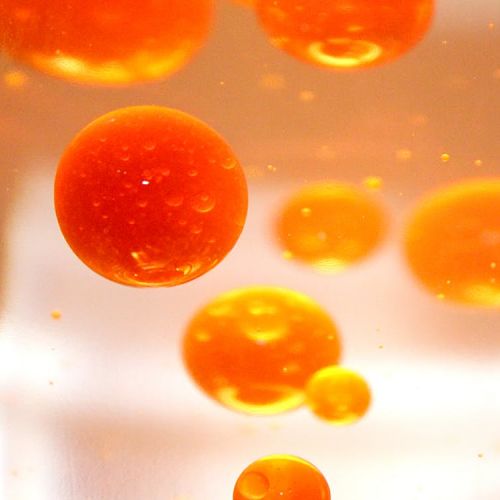
lava-lamp-bubbles-500.jpg

Lava lamps work by taking two substances that don’t mix (usually wax and water) and then heating it to make the ‘lava’ move around. This version doesn’t need wax or heat, just cooking oil, coloured water and a bit of chemistry.

You will need:

•       1 empty plastic bottle (500ml is a good size, still water bottles work best as they have a flat bottom!).

•       Water

•       Food colouring

•       Oil (any vegetable oil will do)

•       Fizzy tablets (soluble vitamin C, cheap versions from a pound shop are perfect!)

•       Small light or torch (pound shop good for this too!)

•       A tray to catch any spillages

First we need to assemble the lava lamp. Stand the bottle on the tray and half fill with water, pop a few drops of food colouring in until you’re happy with the colour. Next, pour in the oil, nearly up to the top (you might need a funnel and a grown-up for this bit!). Leave it to settle for a few minutes, when all the oil is at the top it is ready.

Now to make it move. Drop in a small piece of a fizzy tablet and watch what happens. You should see the bubbles carrying the coloured water up through the oil. You can stand the bottle (carefully!) on a small light or hold a torch underneath it for a real lava lamp effect.

If you want to keep it for another day you can put the lid on … but you MUST wait for it to stop fizzing first. If you put the lid on too soon gas will build up and it could be dangerous.

So how does this work? Oil and water won’t mix because oil is hydrophobic (this means it does NOT like water). The fizzy tablet reacts with the water to make carbon dioxide gas (just like the vinegar and bicarbonate of soda experiments). These bubbles of gas are less dense, basically lighter, than the oil so can bubble up to the top.

You can find lots of experiments to try on our Home Science page…or invite a Fab Scientist to your birthday party or school for more cool science fun!


Getting-gooey-with-Oobleck-500.jpg

Oobleck is simple to make but the most messy fun you can have with your kitchen ingredients. All you need is some cornflour and water, about a cup of water mixed with a cup and a half of cornflour works well. You can add a bit of food colouring if you like. Green is slimetastic but go with any colours you fancy, pink and glittery can be lots of fun.

Now to experiment…

Try to decide if the Oobleck is a solid or a liquid. Try to press it hard, solid or liquid? Try pouring it, solid or liquid? It’s actually neither, it has a fancy scientific name of a ‘non-Newtonian fluid’, this means it can behave like either. Try stabbing it hard with a spoon, suddenly it’s solid, let the spoon rest on top and it sinks. Weird, huh? You can squeeze it into a ball, it feels all hard but as soon as you let go (or hand it to an unsuspecting victim!) it will collapse and go runny. Make up your own experiments, get your hands in it, get gooey and have fun. When you’re done, leave it to dry and keep for another day (don’t use it in the gravy though!).

Good vibrations

The Oobleck gets even more odd if you get them vibrating. I’ve put some on an old speaker (covered in clingfilm) and played some loud music through it. If you get the right sounds, the oobleck will start to jump and dance about. There is a video on our Facebook page if you want to see this without risking your speakers! There are also some amazing videos on YouTube of people who have taken the oobleck experimenting to the extreme by filling whole swimming pools with it!

So what’s going on?

The tiny bits of cornflour have jagged edges, when you press them together they get stuck and can’t move past each other, so you have a solid. If you stop pressing, they come unstuck and can flow again like a liquid.

There are lots more home science experiments to try on our Home Science page. Or invite a Fab Scientist to your birthday party or school and we’ll bring all the kit and take away the mess!


Stack-of-gifts-500.jpg

Check out any toy shop for a big selection of science kits and toys…there are so many to choose from! But which ones will keep your young scientists excited and engaged beyond Christmas or their birthday? Here are our top picks:

Hot Wires kit by John Adams

Hot Wires electronics set by John Adams – around £49.99

We love this kit! It is immediately accessible; anyone with no prior knowledge of electronics can make something that works within minutes of opening the box. There are so many more complex things to try as you build confidence and infinite possibilities to test out your own ideas. Everything fits together easily, making experimenting and rebuilding and (we particularly love this as we are geeks) all of the components have the circuit symbols on! Top tip: The John Adams website sells all the pieces as spares at very reasonable prices. Remember this when your budding electronic engineer loses the yellow spinner (you might want to buy two at a time). The kit itself can be found in most large toy shops or online retailers.

Virtuali-tee by Curiscope

Virtuali-tee T-shirt by Curiscope – £24.99

We use an adult-sized version of this T-shirt for our Brilliant Bodies camps and workshops and it goes down a storm! It is just a blue T-shirt with a funny pixelated skeleton pattern on the front, you might think it does not exactly look exciting. However, download the free app on your phone or tablet, point it at the T-shirt and you can see inside your own body! Of course, it’s not really x-ray vision but it looks pretty real; it’s 3D, it moves with your body and even has a beating heart. We hook it up to a projector when we are working with big groups but it’s just as effective on a small screen when you only need one or two people to be able to see it. You can buy direct from Curiscope or other online retailers.

Whizz Pop Bang - our favourite magazine

Whizz Pop Bang magazine – £39.99 annual subscription

OK, so this isn’t a toy but Whizz Pop Bang inspires our kids to try out more science experiments than any chemistry set we’ve ever bought! This magazine was created by the fabulous Jenny Inglis (who used to be a science presenter on Blue Peter) and it is full of interesting facts, experiments to try and interviews with real scientists. They don’t allow any advertising in the magazine, it doesn’t come with any plastic tat stuck to the front and it’s even delivered in a paper envelope. You can subscribe (if it’s for Christmas they often do offers that include a free book or similar) or buy individual copies for £3.99. Each month is a different theme so you may want to search through the back catalogue for titles that will really grab your young scientist’s imagination…Ploptastic Poo for example! Subscriptions and back issues are all available direct from Whizz Pop Bang.

Natural History Museum pocket microscope

Natural History Museum pocket microscope – £12 (+P&P)

Many of our activities at Fab Science events need us to see things that are very small, from bug-hunting to analysing fibres in Fab Forensics. Over time, we have spent a small fortune on various microscopes that didn’t quite fit the bill…until we found this one. We have ten of these and they have been thoroughly road-tested by our young Fab Scientists. They have been used indoors, outdoors, in mud, in bright light, in dim light, upside-down, sitting quietly, running around…and they are all still going! They will take a normal microscope slide but can also be used without the stage so you can put it straight onto the surface that you want to look at. The magnification isn’t huge at x40 but this is plenty to make everyday objects way more interesting. You can buy direct from the Natural History Museum website or usual online retailers.


Top trumps Chemical Elements

Chemical Elements Top Trumps – £6

If your child loves Top Trumps and loves science…this is a perfect stocking filler! The set was designed by the Royal Society for Chemistry so the numbers are real (no ‘Cool Ratings’ here) and players learn about the elements while enjoying the game. Each card even includes interesting facts as well the chemical symbol but is bright, colourful and fun.

You can buy direct from the RSC bookshop or usual retailers.

Fab Science party experiment kit

Make your own chemistry kit

We’ve tested a few chemistry kits and haven’t yet found one that really excites us. There is often too much plastic packaging and not enough actual stuff to do anything! We’re happy to be proven wrong though so do let us know if there’s one we’ve missed. If you have a little chemist at home who wants to turn your kitchen into a lab, here’s a list of basics to get them going.

  • Goggles – kids ones tend to be a bit rubbish, just buy grown up ones (from a hardware store) with an elasticated band that can be adjusted. Get a couple of pairs so they can experiment with a friend (or for when you want to join in)
  • Plastic test tubes (6-10) and a rack to put them in
  • Beakers
  • Small measuring jug
  • Plastic pipettes
  • Funnels
  • A big tray to catch any spills 🙂
  • Things from around the house such as old spoons, empty plastic bottles, balloons, squeezy bottles etc.

All of this can found in many places locally or online. Strangely, we’ve found the best supplier of reasonably priced test tubes, racks, beakers etc is Cream Supplies. They do ‘molecular gastronomy’ equipment but it’s perfect for kitchen science! For ideas on experiments to try out, see our ‘home science‘ pages.


Potions-500.png

Potty Potions parties by Fab Science are perfect for young witches and wizards! Professor Fab (an actual witch) will visit your home or party venue and show you how to make colour-changing potions, levitation spells, expanding marshmallows, toothpaste for giants and magically inflating balloons. If you’re really lucky, you might even get to try your hand at Patronus training! With dry ice special effects and spells from Professor Fab’s magic book to make it a truly magical experience for Hogwarts fans.

You can ask your friends to don their robes (or come disguised as muggles) and have their wands at the ready. We don’t provide the decorations or food but we’re happy to share ideas from other potions parties that we’ve been to. We’ve seen amazing cakes such as this Golden Snitch by the very talented Caroline at Knebworth Cakes or you can make a very effective spell book from a simple rectangular cake. You might use a Marauder’s Map to hunt for the party bags or hide little Golden Snitches around the venue for guests to seek out while waiting for everyone to arrive. Lay out long tables for a feast in the Great Hall and use the sorting hat to work out the seating plan! Stock up on cut-price decorations after Halloween if you are planning a wizarding science party soon. We’ve collected some of our favourite ideas on our Harry Potter Pinterest board.

You’ll probably want to make some butterbeer; cream soda with a bit of vanilla ice cream to froth it up seems to be a popular recipe but you can make it any way you like. As long as you tell the guests it’s butterbeer…then it IS butterbeer! You can buy ‘genuine’ wizarding sweets such as every flavour beans and chocolate frogs online. However, it would only be a little cheat to use standard jelly beans and Freddos though! Make labels for jars, drinks or plates of food using the aptly named ‘Harry P’ font.

There are a million ideas for decorations, food, drink and games on Pinterest…but there’s only one Professor Fab! Contact us today for availability and a quote.

Mischief managed!

Back to party page


dress-as-a-scientist-cat_opt.jpg

So, you’ve had a letter home announcing there’s going to be a ‘Dress as a Scientist’ day and you’ve got no idea where to start! Of course, if you’ve got the time and your budget allows, you can pick up some great costumes from online retailers such as Amazon and Ebay. However, it’s more fun, economical and eco-friendly to make a great costume with things you’ve probably already got at home. Whether you want to go with the traditional ‘lab coat and goggles’ look or something a bit different, we’ve put together a few ideas to help.

What do people think when you say scientist? Lab coats of course! If you happen to have one great, you’re half way there! But if not, an oversized white shirt or T-shirt, perhaps from an older sibling, would do just as well. You can draw on a T-shirt to make it look like a lab coat with collar, pockets and maybe a few random stains! Now all you need to do is accessorise. Carry a clip board, wear some goggles and put a pen and pencil in a top pocket. Have your young scientist make an identity badge for themselves that you can make into a lanyard.

Although a lab coat is the most obvious way to identify a scientist, actually most scientists look pretty ordinary. Many go about their work in everyday clothes but that wouldn’t make for a very exciting dressing up day! However, you don’t need a lab coat to dress as a scientist; carry a cuddly dolphin to be a marine biologist, wear a boiler suit to be a forensic scientist or bring a toy dinosaur to be a palaeontologist. Have a look what you have in your dressing up box already; remember astronauts are scientists and many doctors are too. Or how about having a think about some famous scientists and dressing up as one of them? Got a Victorian dress lying about after ‘Dress as a Victorian’ day? A perfect costume to be Ada Lovelace, the first computer programmer! Turn them into Jane Goodall, a primatologist who studied chimpanzees, by having them wear shorts, a shirt, walking boots, having binoculars round their neck and holding a cuddly chimp. Thomas Edison, inventor of the light bulb, can be created with a smart suit and either carrying a light bulb or making one out of paper mache and a balloon. For Isaac Newton, wear a long grey wig and carry an apple! For Galileo, astronomer, wear a long dark robe with a belt tied in the middle and carry a telescope. There are so many scientists that have done really important work, do some research, dress up with clues and have fun asking your friends to work out which scientist you are! Look up Katherine Johnson, Rosalind Franklin, Fazlur Rahman Khan, Alessandro Volta or think of a scientific discovery or invention and find out who the scientist was.

Finally, one of my favourite ideas for dressing up is to be a scientific concept or idea, not a scientist. I’ve seen kids come to school being a black hole, the solar system, DNA, gravity, the digestive system, an X ray, a rainbow, chemistry, the weather and evolution. Most of these started out as a white T-shirt, lots of felt tips and some great ideas. My favourite ever one though was a T-shirt covered in science questions, everyone had fun trying to work out the answers.

We hope we’ve given you some useful tips to make it fun and stress free to put a costume together. We’d really love to see pictures of your young scientists in their outfits, you can share with us on Facebook, Instagram or Twitter and show us how creative you’ve been!


Ada-Lovelace-Day_opt.jpg

Happy Ada Lovelace Day, Fab Scientists!

Today is a day to celebrate inspirational women in science, technology, engineering and maths (STEM). By celebrating the achievements of these women and increasing their visibility, future generations of young women will hopefully be inspired to pursue careers in these areas. There are events organised around the world in schools, universities, science centres and museums to put the spotlight on today’s female scientists. 

So, who was Ada Lovelace and what did she do to get her own day? Ada was born in London in 1815 and was the daughter of the famous poet Lord Byron. Ada barely knew her father, he abandoned her when she was just a month old and her mother, although not affectionate to her daughter, insisted upon Ada being privately tutored to the highest possible level. At age 17, Ada met Charles Babbage, Lucasian Professor of Mathematics at the University of Cambridge (a position once held by Isaac Newton and more recently by Stephen Hawking) and this meeting changed the course of Ada’s life. Babbage was working on a calculating machine which he called the difference engine and Ada was immediately intrigued.  She was determined to understand how the difference engine worked, so she asked Babbage for the engine’s blueprints.

She married and had 3 children and developed a strong friendship with Mary Somerville, a leading mathematician of her time. She pursued an interest in advanced mathematics and all the while kept Babbage’s difference engine at the forefront of her mind. Babbage in the meantime had moved on to the analytical engine, which would be capable of far more sophisticated calculations than the difference engine. Ada studied his work along with that of engineer Luigi Menabrea and wrote an extensive paper on the analytical engine. In her paper, she included the world’s first published computer program, or algorithm, and hence she is often cited as the world’s first computer programmer. Ada Lovelace broke new ground in computing, identifying an entirely new concept. She identified through years of study that an analytical engine could go beyond numbers, not just a calculator, but a machine that could contribute to other areas of human endeavour, for example composing music. And so, the first concept of a modern computer was born!

Ada passed away in 1851 at the very young age of 36 but what she achieved in her short lifetime was quite incredible, particularly given the limited education opportunities available to women at the time. She contributed to work so ahead of its time, it would take another 100 years to be fully understood! She nurtured her thirst for knowledge and understanding and paved the way for future female scientists to develop in their chosen field.

Ada is one of many amazing female scientists such as  Marie Curie, a physicist and chemist who conducted pioneering research on radioactivity; Rosalind Franklin who made critical contributions to the understanding of molecular structures of DNA; Grace Hopper, one of the first programmers of the Harvard Mark I computer; Rachel Carson, a marine biologist credited with advancing the global environmental movement; Dian Fossey, a primatologist who undertook an extensive study of mountain gorillas; Vera Rubin, an astronomer who pioneered work on galaxy rotation rates; Gerty Cory, the first woman to be awarded the Nobel Prize in Physiology. Any of these or many others could have had this day named for them, they are all inspirational to the next generation of girls who may follow them into the awesomeness of science.

So here’s to Ada, all the women in STEM and all the girls just waiting to show us what they’ve got. We can’t wait to see who we’ll be celebrating on Ada Lovelace Day in the future!

Ada Lovelace quote

If you would like to inspire your budding scientists (girls and boys!), book them into our holiday science camps, give them a birthday party that they’ll remember forever or ask your school about getting a visit from Fab Science.


World-environment-day-500.png

If you can’t reuse it, refuse it!

On this #WorldEnvironmentDay the big focus is plastic. Plastics are fantastic materials that can be used for all sorts of things. They can made into different shapes, they can be hard, soft, flexible, rough, smooth, opaque, transparent, strong, durable, waterproof, they can be any colour and they never go rusty! Just have a look at all of the things in your house that are made of plastic (0r a least partly).

Unfortunately, it’s not all good news though. Most plastics take a very long time (hundreds of years) to break down. That’s not too bad if you buy something and use it for a long time but if you use it and throw it away it will add to the mountain of plastic that is just not going away. It’s in landfill sites, in the oceans, in fish’s tummies, on beaches and all around us. That’s really sad.

So what can we do? Just remember the three Rs….Reduce, Reuse, Recycle.

REDUCE: this is the most important one. It’s best to use less plastic in the first place. Could you use something else? Do you really need it anyway? Try to choose things that have as little packaging as possible. If companies realise that people won’t buy their products if they are overly packaged, they will reduce it. You can even get your grown ups to remind the government how important you think this is by signing this petition by Friends of the Earth. DO ONE THING: stop using drinking straws or get a reusable one.

REUSE:  Try to only buy reusable plastics…and then make sure you reuse them! Can you use old tubs to keep things in? Can you carry your packed lunch in reusable boxes instead of plastic bags? Remember, it doesn’t need to be you that reuses the things, can you pass them on to someone else when you’re done? Take care of your toys and donate them to charity shops or even sell them when you have grown out of them. DO ONE THING: use a refillable water bottle and make sure you always remember it on days out. There’s no point buying a refillable bottle and then buying more bottles because you have forgotten it!

RECYCLE: This is the one that we are usually pretty good at BUT it should only be a last resort. Plastics aren’t easy to recycle so lots of what goes into the recycling bins won’t actually be used. Really try to make sure that you are reducing and reusing plastics as much as possible first. DO ONE THING: volunteer to sort out the recycling at home. Make sure plastic film is taken off trays as this can mean that a whole lorry load will go to landfill if they can’t recycle it.

Would you like to know more about World Environment Day? You can visit the website for news stories from across the world on how people are finding new ways to reduce their use of plastic.

National Geographic have lots of information about how much plastic we use and what we can do about it. A million plastic bottles a minute is pretty hard to imagine.

You can even get involved in a huge science project with the Litterati app. You can help clean up your local area, while also gathering information which will show which big companies are the worst for making litter.

Let’s all work together to #BeatPlasticPollution!


geode500.jpg

Fun with crystals

If you look closely at sugar or salt, you will see it is made up of lots of little crystals. We can ‘grow’ bigger crystals if we start from scratch and let them form slowly. So how do we make a crystal from scratch? We need to dissolve the salt or sugar and then let it recrystalise. You can try out these two experiments to make some rock candy and geodes. Both of these involve boiling water so definitely one for some grown-up help.

Rock candy

Heat a cupful of water in a pan until it is boiling. Then start adding sugar. Stir, add more sugar, stir, add more sugar, stir…you get the idea! Keep going until you cannot get any more to dissolve, this should be at least two cupfuls. This is called a saturated solution. Let the mixture cool down for around 20 minutes then pour into a tall glass. When the solution cools we say it supersaturated, this means it now has more sugar than it can normally hold. It’s ready to start growing crystals! If you hang a bamboo skewer into the glass (use a clothes-peg to keep it in place), crystals of sugar will start to form on the skewer. Remember we need SLOW formation so it will take a few days, perhaps even a week, be patient! It’s really important that it is left undisturbed for this time so put it somewhere out of the way.

Geodes

Geodes are mineral crystals found inside rocks, we can make our own inside eggshells. Make sure the eggshells are perfectly clean and the membrane has come away from the inside. Make a saturated solution like you did before, you can use sugar or try table salt or Epsom salts, then add a little food colouring. Pop the shells in an egg box and fill with this solution, the fuller the better but make sure they won’t spill! Leave them somewhere safe to evaporate and in a few days you should see the geodes form!

Crystals in nature

Crystals form in nature when some things become solids. This can be rocks that were molten (lava) or minerals that were dissolved in water. Molten rocks will solidify as they cool, dissolved mineral will crystalise as the water evaporates.

The size of the crystals depends on the time that they take to form. Fast=small, slow=big. Igneous rocks (ones that are made from lava or magma) might have small crystals if they came from a volcano as they would cool quickly in the air. Sometimes igneous rocks can be made slowly underground and we can often see larger crystals in these. Geodes come from dissolved minerals seeping into gaps in other rocks, the water evaporates soooo slowly that we get beautiful big crystals. You can try putting your egg geodes in different places when they are evaporating, perhaps one on a radiator, one on a windowsill and one somewhere cold. Just make sure they’re not going to get knocked over!